
“That was quite brilliant,” said Anthea Turner, the British TV presenter amid rapturous applause.
Turning to the guest on her show, she said, “And words fail us apart from, ‘excellent and thank you very much’.”
As Turner continued to speak, she suddenly started to blush as her guest leaned in to kiss her on either cheek.
“Thank you so much!” she gushed, turning to the guest. “Ladies and gentlemen…. Juan Tamariz!”
As the applause reached a crescendo, the camera panned to a wiry, middle-aged, long-haired man, who was playing an imaginary violin with his hands. His eyes half-closed, and with a smile playing on his lips, he hummed softly, “Ta-Ra-Ra! Ta-Ra-Ra! Ta-Ra-Ra!.”
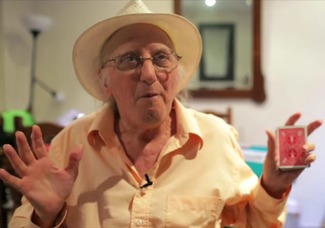
Tamariz had just startled a bunch of viewers who had gathered around him – as well as the audience in the TV studio – with some astonishing card magic done at close quarters.
Tamariz, who passed away earlier this month, is regarded by many as one of the greatest magicians in history and one of the “great originals of magic,” as Turner herself called him in her show (‘The Best of Magic,’ aired in 1990). More recently, The New York Times called Tamariz ‘The Man Who Made Spain The Magic Capital Of The World’ in a 2023 profile.
Tamariz, who died at 83, was an acclaimed master of close-up card magic, capable of confounding audiences seated at touching distance even as he charmed them with playful humour. With his kinetic energy, warmth and ever-present glasses, he looked more an eccentric professor than a showman.
Speaking about his craft, Tamariz once said – in broken English – in a documentary called ‘Our Magic,’ “The more work you put (into) an effect, a trick, an illusion, a dream, (you will elicit from the spectator) more strong reaction, more deep reaction and more feeling and emotion.
“How (do) they know that you put more effort and more work?” he asked rhetorically.
“They don’t know, but they feel.”
On February 21, 2026, the fans of Bundesliga club FSV Mainz 05 showed exactly how they felt about Urs Fischer, their new coach.
Less than three months into the job, Fischer was already a popular man at the Mewa Arena, Mainz’s home ground. After taking over with Mainz bottom of the league, Fischer had already lifted them up to 14th place, two points above relegation spots. On this February evening, the Mainz fans had come together to wish Fischer a ‘Happy Birthday’ as he had turned 60 just a day earlier.
As a shy Fischer stood on the pitch with his head bowed at the Mewa Arena, the entire stadium came together to serenade a ‘Happy Birthday’ to him.
A Man Who Knows How To Lose
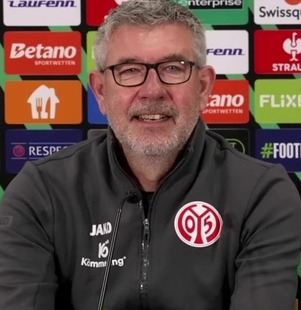
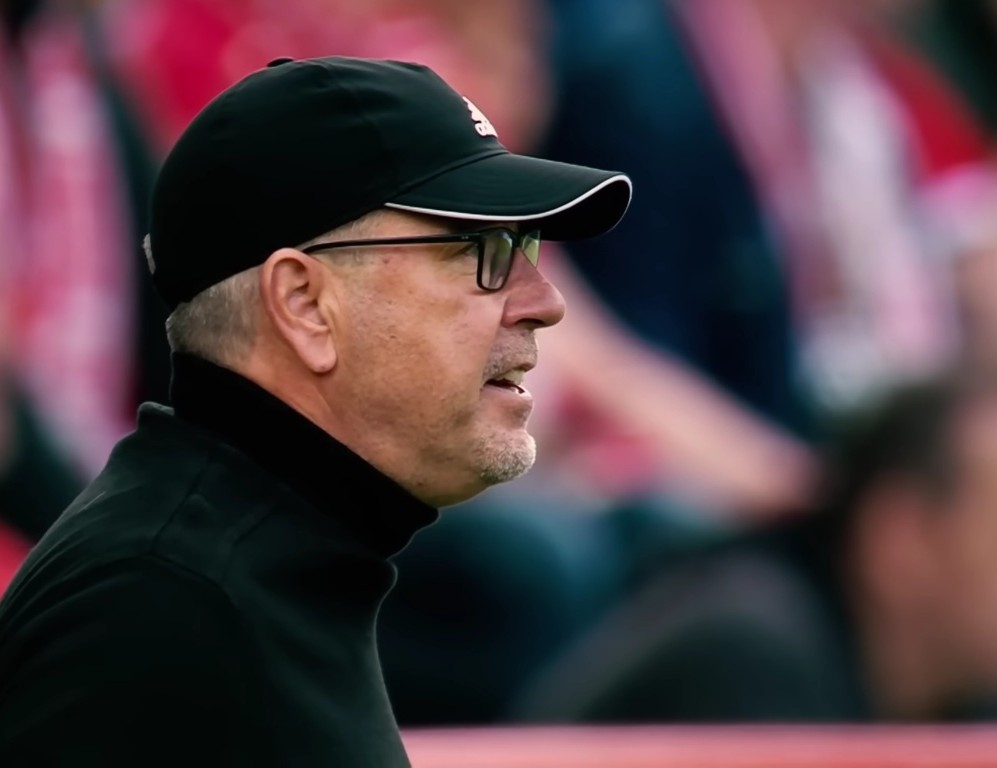
Urs Fischer knows how to lose.
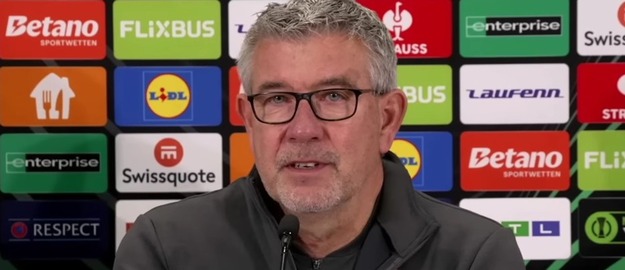
Standing in Union Berlin’s training ground in November 2023, Fischer was speaking to the media after being sacked as the coach after five historic seasons in charge of Union.
Still in tracksuits and holding a mike in hand, he looked emotional.
“On the one hand, though we really tried everything to break this negative spiral, we just couldn’t manage it,” the Swiss coach said.
“On the other hand…” Fischer paused.
He looked down at his feet.
The words seemed to stick in his throat.
“It’s right,” he said, finally looking up at the camera. “It’s right (it turned out) this way.”
Fischer had been sacked as the Union Berlin coach after a run of 14 winless games, which included 13 defeats.
But Fischer still left Union a hero.
Because Fischer also knows how to win.
In the five seasons preceding his dismissal, the Swiss coach had helped Union reach the Bundesliga for the first time in their history, and then helped them qualify for the UEFA Conference League, the UEFA Europa League and the UEFA Champions League in subsequent seasons. Each season in charge of Union, he had taken them a step up the footballing ladder.
After more than two years out of coaching, Fischer returned as head coach of FSV Mainz in December 2025, when Mainz (also called FSV or the 05ers) were bottom of the Bundesliga. They had 6 points and were 5 points off safety.
After 21 league matches under Fischer, FSV finished the 2025/26 Bundesliga season in 10th place, with 40 points.
To put Mainz’s improvement in context, consider this: since Fischer took over, only six teams collected more points in the league. All six finished in the top six positions of the 2025/26 Bundesliga table. Though the 05ers eventually failed to qualify for Europe, the lack of European football is bound to help FSV in their domestic campaign in the upcoming season. Mainz will be trying to stabilise their stay in the Bundesliga this season and are bound to come up against teams trying to balance midweek European games, league and domestic cup fixtures. FSV’s lighter workload is likely to give them an edge.
A BRACING START
Fischer’s first match in charge of Mainz was a UEFA Conference League Group Stage match against Lech Poznan in Poland, which Mainz drew 1-1.
But the Swiss coach’s real test came in his next match, his league debut on the FSV bench when they visited champions Bayern Munich.
Going into the tie, the Bavarians were flying, eight points clear at the top of the table and still unbeaten in the league. It was first versus the lowest placed team in the Bundesliga.
But the 05ers held the champions to a 2-2 draw in Munich, only a late Harry Kane penalty denying FSV all three points.

“Before the game I definitely would’ve taken a point in Munich,” said Mainz right-back Danny da Costa. “But when you’re leading 2-1 near the end, you’d obviously like all three (points). So I’m a bit disappointed, but I think I’ll see things differently tomorrow.”
The ‘tomorrow’ da Costa spoke about arrived in glorious form for Mainz, with FSV shooting up the table in the ensuing matchdays. By the time Mainz hosted Bayern at the Mewa Arena for the reverse fixture in April 2026, FSV stood 10th in the table.
UP FOR A GAME, BUT THIRSTY FOR WAR
“Only 17 games have passed. Now 17 more are coming. So we play everyone again.”
— Klaas-Jan Huntelaar, FC Schalke striker
Dutch striker Huntelaar was speaking on January 20, 2021, after Schalke had just lost 1-2 to FC Koln. The defeat left Schalke in 18th place and bottom of the Bundesliga table, 8 points off safety.
Just one place above them — only on superior goal difference — were Mainz. In the end, despite Huntelaar’s optimism, Schalke were relegated from the Bundesliga that season.
Mainz could have joined them in the second division, but didn’t.
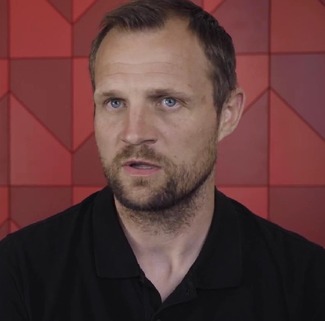
Under Danish coach Bo Svensson — brought in mid-season after a disastrous start to the season — FSV completed an incredible fightback to secure their Bundesliga status.
“Every time a team is in a difficult situation or somebody is down and nobody reckons with them anymore, we will be an example for exactly the opposite,” said a proud Svensson in May 2021 after completing Mainz’s spectacular comeback.
But Mainz seem to have made coming back from the dead a bit of a habit. In the five seasons that have followed FSV’s great escape under Svensson, the 05ers have been involved in two more relegation dogfights — during the the 2023/24 season and the 2025/26 season. It’s almost as if the thrill of a battle against the drop acts like catnip, and Mainz are only able to resist its lure for so long.
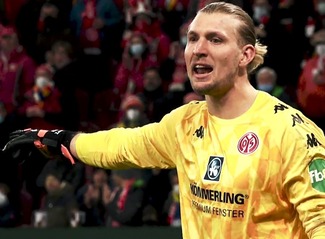
“To think this is something you can simply take for granted is a dangerous mindset,” said Mainz goalkeeper Robin Zentner in August 2026. “We already said two years ago that enough was enough (after the battle for survival under Bo Henriksen in 2024). We want to become more stable and continue to develop, and certainly not keep swinging from one extreme to the other.”
While Mainz do seem to have developed a bias towards danger, this habit ended up yielding an unintended edge over rivals: when Fischer arrived in December 2025, he already had a clutch of battle-scarred veterans he could turn to, players who had helped FSV weather their last two battles with relegation.
Zentner, Stefan Bell, Danny da Costa, Phillipp Mwene and Dominik Kohr are all still first-team regulars at Mainz after surviving the relegation battles of the 2020/21 and 2023/24 seasons.
“We have players of established quality and experience, but we’re just not performing well enough,” said a frustrated Bell after Mainz had lost 0-4 to Freiburg in December 2025.
“Most of our players are miles away from last season’s form. Every player must question himself individually.”
The defeat to Freiburg marked a watershed moment, as Mainz sacked coach Henriksen shortly thereafter and appointed Fischer.
German centre-back Danny da Costa extolled the change brought about by Fischer. “Under him, the team has a pretty clear concept of how we want to operate on the pitch, close the space and get into our transition moments,” he told the Copa TS podcast in March 2026.
“Urs Fischer was an absolute stroke of luck,” recalled FSV captain and right-back Silvan Widmer in March 2026. “In Urs, we were able to recruit an experienced man who turned the right screws,” said Widmer, who was part of FSV’s battle against relegation in the 2023/24 season.
Phillipp Mwene, an Austrian who can play as both left- and right-back, observed how Fischer’s counter-attacking, safety-first football has made Mainz more “compact.” “Everything is a bit more organised. There are fewer pressing phases in our game than before, when we perhaps left bigger gaps for the opponent,” Mwene told SWR Sport in March 2026. “Now we’re always very compact. I think it’s really difficult to create scoring opportunities against us.”
WHAT FISCHER CHANGED
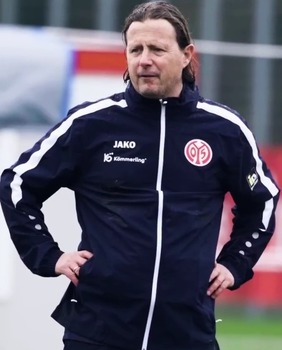
Right after taking over FSV, Fischer was candid about how he wanted Mainz to perform: “Be nasty and tireless, compact, organized, and a long ball is always a factor. Getting the simple things onto the pitch, that’s the approach.”
The Swiss had no issues with being labelled ‘down-to-earth and pragmatic.’ “I’m happy to allow that,” he said. But he warned his players that he was ready to be unpopular with them if necessary. When he demands something, Fischer said, he could be inflexible.
“That’s when I can be nasty.”
Then he got to work.
a) Tightening up defence, changing formation
The first thing Fischer did after taking over at the Mewa Arena was to tighten up the defence.
“It was primarily about tweaking the little things and achieving a certain stability through organization on the field,” said Fischer in an interview with German magazine Kicker in early April, while looking back at his initial days in charge of FSV.
“We managed that quite well in the 1-1 draw against Lech Poznan (in the UEFA Conference League). Then we had to face Bayern. Getting a 2-2 draw there is probably worth more than a win elsewhere.”
The Swiss coach spent a lot of time in individual discussions with the players. “He takes a lot of time in video analysis,” said da Costa in the podcast. “He shows the defender alternative solutions and makes visible areas of play in which I can move better.”
| Category | Goals Conceded Before Fischer | Goals Conceded Under Fischer |
| In Bundesliga | 24 | 29 |
| Other competitions | 7 | 5 |
| Total goals conceded | 31 | 34 |
| Total matches | 21 | 27 |
| Goals conceded per match | 1.47 | 1.25 |
Source: www.transfermarkt.co.in
Fischer also changed FSV’s formation. He went from an attacking 3-4-2-1 that was leaking goals, to a 3-5-2 structure (which became a 5-3-2 when Mainz didn’t have the ball) that made the team much harder to break down.
While Henriksen’s Mainz defended high up the pitch, FSV’s defence now sat a bit deeper. The 05ers now relied more on counter-attacks and rapid transitions, rather than on Henriksen’s aggressive, front-foot style football that demanded more risks from the team.
In the 13 Bundesliga matches that had preceded Fischer’s arrival, Mainz had lost nine (eight under Henriksen, one under a caretaker manager). Under Fischer, FSV immediately went on a five-match unbeaten streak. They would lose only five times in the Bundesliga for the rest of the season.
b) Focusing on set-pieces
As part of bringing a more pragmatic brand of football to the Mewa Arena, Fischer focused on making Mainz stronger on set-pieces. Prior to Fischer’s arrival, Mainz had scored just four set-piece goals all season across competitions — all of them penalties. Under the Swiss tactician, however, FSV fared far better in dead-ball situations — a feature that was a mark of Fischer’s Union Berlin, too.
| Category | Set-piece Goals Before Fischer | Set-piece Goals Under Fischer |
| In Bundesliga | 2 | 8 |
| Other competitions | 2 | 2 |
| Total set-piece goals | 4 | 10 |
| Total no. of goals | 21 | 40 |
| Set-piece break up | All penalties | 6 penalties, 3 corners, 1 free kick |
| % of set-piece goals out of total goals | 11.18% (league) 19.04% (in total) | 24.24% (league) 25% (in total) |
Source: www.transfermarkt.co.in
c) Freeing up Amiri and Lee

Fischer also gave more freedom to central midfielders Nadiem Amiri and Lee Jae-Sung to move up the pitch. In the case of Amiri, he began deploying the German as an attacking midfielder instead of central midfielder. Amiri prospered in the role, finishing as Mainz’s top-scorer for the season — he registered 10 goals and 2 assists across competitions since his change of position. In the end, Amiri finished with 17 goals and 4 assists for the season. South Korean Lee, too, scored 3 goals and 3 assists across competitions after being given more freedom to venture forward.
d) Calm after the storm
Bo Henriksen’s was an unmistakable presence on the touchline, his golden locks and bubbly energy marking him out like a polar bear in the Sahara. Fischer’s, on the other hand, is more studied and guarded. No wonder his favourite hobby is fishing.
Fischer discovered his love for fishing fairly late in life. When he was coaching Swiss team Basel in 2015, the Swiss tactician accompanied one of his goalkeepers for a session of fly fishing.
Initially, Fischer thought “Fly fishing is not for me.”
“Until I held the rod in my hand. One or two casts were all it took — since then I’ve discovered a new passion,” he told Swiss website Bluewin when recalling the experience.
Fischer believes fishing holds lessons that are applicable in football too. “You don’t always get a result,” he told German daily Neue Zurcher Zeitung in February 2023. “You can fish for a day and catch nothing. As a coach, I try to adjust something, maybe change the bait, try another strategy until we catch something.”
It had been a “deliberate” choice by Mainz to appoint someone who was a “contrast” to Henriksen, said FSV Board Member for Sports and Communication Christian Heidel at the time of Fischer’s unveiling. “If we had brought a similar type of person to Mainz, that wouldn’t have been good,” Heidel said. “We need a contrast now and a different approach.”
The gamble seems to have worked.
“(Fischer) has brought a lot of calmness and clear structures to the team,” said midfielder Paul Nebel in April 2026. “Week by week, we’ve improved in the areas he focuses on, which has made us more stable. As a result, our confidence has steadily grown again.”
Nebel had initially lost his place in the playing 11 under Fischer, but regained it after stepping in effectively for top-scorer Amiri, following an injury to the latter. Nebel is now a crucial part of the first team.
e) Making vital additions in January transfer window

The January transfer window saw Mainz bring in four players. Two of them – Stefan Posch and Phillip Tietz – went on to play crucial roles in FSV’s charge up the Bundesliga table.
Tietz, an old-school centre-forward, brought a lot more than just goals to FSV. His unflagging defensive work and link-up play improved Mainz’s all-round game, and he quickly became a popular figure in the dressing room and in the stands.
“I’ve already built a really good connection with Phillip. Off the pitch as well,” said Amiri in January, barely a month after Tietz had joined Mainz.
Tietz has been a prolific scorer in the lower reaches of German football, reaching double figures on five occasions earlier in his career. But his move to Bundesliga club Augsburg in 2023 did not play out as expected. A return of just 17 goals in 85 appearances saw him labelled a disappointment and when FSV gave him a chance to relaunch his career in January, he readily joined.
Tietz ended up scoring 5 goals and making 4 assists for Mainz, but he was hungry for more. “To be honest, I’m not entirely satisfied. I could easily have scored 2 or 3 more (this season),” Tietz said after FSV’s victory at St.Pauli in early May.
Tietz’s performance at St.Pauli was typical – he was selfless inside and outside the box with link-up play and excelled in defensive work. He capped it with a goal and an assist, which helped FSV beat St.Pauli and clinch Bundesliga survival for one more season.

After the game, Tietz explained his attitude on the pitch. “If I can help the team by holding the ball up, flicking it on, setting up a goal or playing the pass before the assist, then that’s enough for me as long as we pick up points,” he told Mainz’s official website. “If I can add a goal on top of that, all the better.”
Stefan Posch is originally a centre-back but had been playing primarily at right-back for club and country for the past few seasons. After joining Mainz on loan from Italian club Como though, the Austrian was deployed in Fischer’s three-man backline and became an immovable object in FSV’s defence. Mainz played 20 matches after the centre-back’s arrival in January and the Austrian started every one of them.
A dominant presence aerially, Posch is also a goal threat from set-pieces. He offers a composed presence on the ball. “He dares to do something in the game with the ball. He has good speed and anticipates situations well,” said Fischer when Posch signed for Mainz.
FSV were hopeful of making Posch’s stay at the MEWA Arena permanent and finally succeeded in sealing the transfer from Como in mid-August.
Building For 2026/27
Mainz have strengthened themselves ahead of next season, and have so far made seven first-team signings – four new signings and three loanees whose stays at FSV were made permanent.
Ransford Konigsdorffer was the first to arrive, the 24-year-old forward joining on a free transfer from Bundesliga club Hamburger SV. Konigsdorffer left Hamburg after what had been a disappointing first season in the Bundesliga (he scored 6 goals) but he still retains blistering pace and the ability to stretch opposing defences during transition.
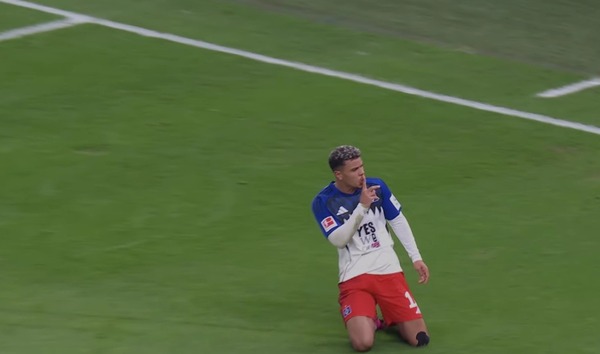
Before his underwhelming debut Bundesliga season, ‘Ransi’ – as he is popularly known – was prolific in the German second division for Hamburg. In the 2024/25 season, he headlined Hamburg’s promotion push by scoring 14 times and making 4 assists. In May 2025, Hamburg clinched automatic promotion after seven years out of the top flight.
Konigsdorffer is likely to compete with Sheraldo Becker, Benedict Hollerbach and Silas Mvumpa for the opportunity to partner Phillip Tietz up front. The 24-year-old’s searing pace can also be put to use on either wing, or in attacking midfield. “I’m really looking forward to this new challenge here in Mainz. The talks here gave me a very clear idea of the plan the head coach and the club have for me, and that was really convincing,” said Konigsdorffer during his unveiling as a Mainz player.
The next to join FSV was Eric Martel, a traditional number 6 who specialises in breaking up play and shielding the defence behind him. Besides playing as a defensive midfielder, Martel can also be deployed as a centre-back.
Martel comes to Mainz highly recommended. “He is one of the best German number sixes we have in the Bundesliga,” iconic former Germany captain Lothar Mattheus said in September 2025. “He is the (Joshua) Kimmich of FC Koln.”

The 24-year-old Martel’s signing can be seen as a possible back-up to Kaishu Sano, FSV’s current number 6 who is one of the best defensive midfielders in the Bundesliga – or as a replacement for the Japanese international. Following an excellent season for Mainz, Sano shone for Japan at the 2026 World Cup, reportedly sparking interest from Borussia Dortmund, Manchester United and Liverpool.
If Sano does leave, Mainz have a solid replacement lined up.
However, there are two issues Mainz will first have to contend with: the first is Martel’s injury, which he sustained during a friendly in early August. The German is expected to be sidelined for at least a few weeks. The second issue is the midfielder’s worrying habit of picking up unnecessary yellow cards. Martel’s 12 yellow cards were the most collected by a player in the Bundesliga last season. The German missed three league matches as a result. Koln lost two of those and drew the other.
The next to arrive at Mainz was Fabio Gruber, a centre-back from German second division club FC Nurnberg.
Gruber, a German of Peruvian descent, was one of the best defenders in the 2.Bundesliga last season. He ranked second in aerial duels won (169), with only Nikola Katic (Schalke FC, with 192) ahead of him. He also ranked in the 96th percentile among defenders in clearances made. Gruber is also known for his leadership skills. After Nurnberg captain Robin Knoche transferred to Arminia Bielefeld midway through last season, Nurnberg coach Miroslav Klose named Gruber – still in his first season at the club – the captain for the second half of the season.

“We are signing a young centre-back with outstanding character, who defends with real authority and is composed in possession. He has already shown real leadership qualities at his previous clubs,” said Niko Bungert at Gruber’s unveiling.
In November 2025, Gruber received his first call-up to the Peru national team. “He’s a lad with a lot of personality, character, and intelligence,” said Javier Pinola, Nuremberg’s assistant coach, at the time of Gruber’s call-up. “He has tremendous potential to keep developing.”
The last new signing to arrive was Alexander Schwolow, signed from Heart of Midlothian, as a back-up keeper to Robin Zentner. Schwolow was signed after Daniel Batz, Mainz’s back-up keeper for the past three seasons, joined Borussia Monchengladbach in the summer.
Schwolow has big boots to fill. Batz was one of FSV’s heroes last season, filling in splendidly for Zentner after the Mainz number one was sidelined for several months due to injury. There were several times when Batz kept Mainz in the game single-handedly, which eventually helped FSV retain their Bundesliga status.
“It was very important that we had a number two like him. He played very, very well, and that’s also how we stayed in the league,” said Zentner in May 2026. Batz left FSV after agreeing a lucrative contract from Monchengladbach.
Schwolow, though, should find it easy to hit the ground running. The 34-year-old has extensive Bundesliga experience, having spent all but one season of his career in Germany. He has also already worked under Fischer, at Union Berlin. Though Schwolow did not make a competetive appearance at Union under Fischer, the presence of the Swiss coach was a key factor in him joining Mainz. “(Fischer) works very precisely, very honestly and very hard, and I really appreciate that,” Schwolow told FSV’s official website recently. “I’ll be ready when needed.”
In addition to the four new signings, Mainz also made permanent the loan signings of Stefan Posch (defender, from Como), Sota Kawasaki (midfielder, from Kyoto Sanga) and Sheraldo Becker (winger, from CA Osasuna) following their successful spells at the club.
Finnish talent Otto Ruoppi, who FSV had signed in January 2026 from Finnish club Kuopion Palloseura and loaned back to the club, has also joined the senior squad for the new season. It remains to be seen if the 20-year-old attacking midfielder will continue in the first team or be part of the reserves.
Deficiencies To Work On
When the final whistle blew, Urs Fischer felt a wave of relief. “The tension was gone,” he recalled. “It felt like an emptiness inside, like breathing out. You’re on edge the whole time, and then suddenly that was gone and we had achieved our target.”
Fischer was speaking after Mainz secured their Bundesliga status for the 2026/27 season at St.Pauli, through a 2-1 victory on matchday 32 in May 2026. The Swiss coach had gone one better than FSV had in the 2021/22 season, when Mainz pulled off a similar fightback from the brink, securing safety on matchday 33.
With Bundesliga status secure for at least one more season, these are some areas that Mainz will need to work on:
a) Consistency
In the past six Bundesliga seasons (starting 2020/21), Mainz have finished 12th, 8th, 9th, 13th, 6th and 10th respectively. These include three relegation scraps, one European qualification and two other top 10 finishes. This infuriating lack of consistency is probably the single most important factor Mainz will have to improve upon.
Christian Heidel acknowledged the problem. “It wasn’t as extreme as (at) Wolfsburg (in May 2024), when we stayed up on the final day,” Heidel said after Mainz had secured survival for next season with victory at St.Pauli in May 2026.
“This was another extraordinary effort, but we obviously don’t want to have to produce something like this every year.”
Luckily for Mainz, they might have just the right man for the job in Fischer. Under the Swiss coach, Union Berlin’s trajectory in the Bundesliga was ever acsendant until his dismal final season, which ended in his sacking. Fischer himself admitted that FSV had a consistency problem. “Consistency is something we need to address,” he said, after securing Bundesliga status for one more season. “We have to make sure our level doesn’t drop as much from game to game. There aren’t many teams in the Bundesliga who perform at the same level throughout the season, but we want to be at our best as often as possible.”
b) Dropping Points From Winning Positions
One dramatic improvement that Fischer brought about last season was Mainz’s habit of scoring first in games, which can be crucial during relegation battles. In 21 league matches under Fischer, FSV took the lead an outstanding 14 times. Before Fischer, Mainz had scored first in just three of their first 13 league matches last season. In Europe, in six matches under Fischer, they scored first four times (and twice in four games under Henriksen).
However, there was one glaring shortcoming: Mainz’s habit of dropping points from winning positions.
| Opponent | Winning Till | Result | Points Dropped |
| Bayern (A) | 87’ (leading 2-1) | Drew 2-2 | 2 |
| Union Berlin (A) | 77’ (leading 2-0) | Drew 2-2 | 2 |
| FC Koln (A) | 57’ (leading 1-0) | Lost 1-2 | 3 |
| Hamburg (H) | 64’ (leading 1-0) | Drew 1-1 | 2 |
| Leverkusen (A) | 88′ (leading 1-0) | Drew 1-1 | 2 |
| Stuttgart (H) | 76’ (leading 1-0) | Drew 2-2 | 2 |
| Strasbourg (A)* | Led first-leg 2-0 | Lost 0-4 (2-4 on aggregate) | Knockout match |
| Bayern (H) | 53’ (leading 3-0) | Lost 3-4 | 3 |
*: The match against Strasbourg (away) was a UEFA Conference League match.
Source: www.transfermarkt.co.in
As eye-catching as their Bundesliga survival was last season, FSV still dropped a whopping 16 points from winning positions in the league. In the end, the difference between Mainz (who ended with 40 points) and Freiburg, the team that clinched the final European qualifying spot, was 7 points.
The defeat to Bayern in April 2026 exemplified FSV’s frailty. Despite being 3-0 up against the champions by half-time, Mainz managed to lose the game 3-4. “It’s still hard to find the right words,” said a shocked Fischer after the defeat. “But it’s easy to summarise: we played a top first half and then almost stopped in the second half.”
The capitulation to Bayern was probably FSV’s second worst performance under Fischer last season. Arguably their worst came just a week earlier, when Mainz crashed out of Europe. Mainz had been dreaming of reaching a first-ever European semifinal when, in the UEFA Conference League quarterfinal against RC Strasbourg, Mainz blew a 2-0 first-leg lead and lost 0-4 in their second-leg in France.
FSV failed to create a single scoring chance against the French side in the second leg. Fischer later admitted he had dreaded such a scenario. “It has to be said clearly: we were out of our depth. They ate us up. It was what I feared: we had no answer,” he said.
Though Mainz’s habit of failing to hold on to leads is more of a mental problem, one partial solution may lie in the arrival of Fabio Gruber from FC Nurnberg. If Gruber, along with 18-year-old centre-back Kacper Potulski (who enjoyed an encouraging debut season in the Bundesliga last season), manages to keep centre-back Dominik Kohr away the first 11, Mainz will be a much better outfit in the upcoming season. Kohr tends to compensate for his evident lack of quality with reckless aggression, which sees Mainz leak goals and lands them in unnecessary soups.
c) Improve Finishing Dramatically
Last season, Mainz scored 44 league goals from an xG (Expected Goals) of 53.58 — a deficit of -9.58 (around 10 goals). It was easily the worst record in the Bundesliga, with the next worst being Heidenheim’s (-5.3). Though FSV had mitigating factors last season, such as the injuries to strikers Benedict Hollerbach and Silas Mvumpa (signed in January) that kept both sidelined for large chunks of the campaign, Mainz’s finishing has to improve this season.
| Category | Value | Bundesliga Ranking |
| League goals minus xG deficit | 44-53.58 = -9.58 | 18 |
| Crosses from open play | 400 | 1 |
| Aerial duels won | 767 | 3 |
| Shots against the post and the bar | 16 | Joint second (along with Bayern) |
Sources: www.OddAlerts.com, www.bundesliga.com
It’s not as if the FSV strikers were starved of service in the box — Mainz topped the Bundesliga for most crosses from open play (400) last season. They also stood third in aerial duels won (with 767), so the issue is either bad service or substandard finishing, or both. Mainz’s poor finishing is borne out by the fact that FSV stood joint second in shots against the post and bar (16) in the league last season.
The addition of Sheraldo Becker and Ransford Konigsdorffer on permanent transfers is expected to improve Mainz’s attacking fortunes, but Hollerbach and Silas are still expected to miss the start of the Bundesliga season.
Encouraging Signs Ahead of Next Season
Though there are some challenges that Mainz will have to master, there are some factors that will give them an advantage next season.
a) Nadiem Amiri Stays At FSV
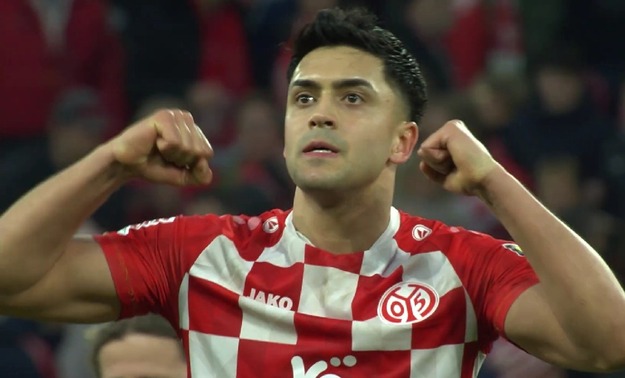
Legion are the times Nadiem Amiri has delighted FSV fans with his exquisite dribbling, outstanding vision and cold-blooded finishing. But probably none of these delighted Mainz fans more than Amiri’s unexpected announcement in early August that he had decided to stay at the club, despite concrete interest from bigger clubs. Amiri, Mainz’s top scorer last season (17 goals, 4 assists) had reportedly agreed personal terms with RB Leipzig, before the move fell through.
“I decided today together with my family that I will definitely stay here,” announced Amiri at a fan event in Austria. “I have a very good feeling.” The surprise declaration was met with roars of approval from the hundreds of Mainz fans present at the event as well as many of Amiri’s teammates, who were also present. Amiri had, just days earlier, refused to publicly commit to FSV.
Amiri is Mainz’s creative fulcrum and benefitted enormously by Fischer’s decision to push him up the field to play as a number 10 instead of as a defensive midfielder. “He (Amiri) brings that creative spark,” said Fischer after deploying the German further forward than usual in Amiri’s first match under Fischer — a 2-0 win in the Conference League over Samsunspor, in which Amiri scored. “He’s a player who can deliver the final pass and he’s a goal threat. I think he enjoyed himself today, and it’s a possibility for the future.”
Mainz would’ve had their task cut out if Amiri had left, because the German had also become a leader in the relatively short span he has spent at FSV (two seasons). Now they can concentrate on improving upon last season’s 10th place finish and dream of qualifying for Europe again.
b) Anthony Caci is fully fit

The versatile Caci missed most of last season due to a hamstring injury. Throughout his career, Caci’s natural role has been as a left-back, left-wingback, left midfield or left-sided centre-back, but under Henriksen during the 2024/25 season, he thrived after being deployed primarily at right midfield. Caci made 7 assists and scored 1 goal, as he became a vital part of a team that finished sixth and qualified for Europe.
Missing out most of last season through injury rankled Caci, especially when Mainz were fighting to stay in the Bundesliga. “I was often sat in the stands during our games, and a lot of fans kept asking when I’d be back,” said Caci in April 2026 after making his return from injury. “That wasn’t always easy to explain, because I wanted to be back on the pitch as quickly as possible, but my body had other ideas.”
Caci’s return is welcome news for FSV, as he likes playing diagonal passes to switch play and delivering accurate crosses into the box, which can be assets in the rapid transitional play that Fischer favours. Under Henriksen, Caci had displaced Silvan Widmer from his usual right midfield spot. Under Fischer though, Widmer had reclaimed his spot and played a crucial part in FSV’s successful fightback against relegation. It will be interesting to see where Fischer decides to deploy Caci.
c) Robin Zentner is fully fit again
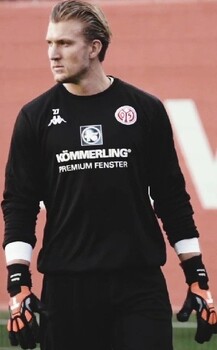
The 31-year-old Zentner is a Mainz lifer, a product of the Mainz academy, which he joined in 2006 when he was 11. He has only ever played for one other club — Holstein Kiel, then in the German third division, when he was sent out on loan early in his career. Zentner has been Mainz’s first-choice goalkeeper since the 2019/20 season and was a crucial part of both of FSV’s successful scraps against relegation in recent years — in the 2020/21 season and in the 2023/24 season.
“He was outstanding,” beamed the then Mainz coach Henriksen in March 2024 during the 2023-24 season, after Zentner had dragged FSV to a 0-0 draw against high-flying RB Leipzig. “Leipzig had an xG value of 2.94, and he alone saved 2.7 of them. That’s not normal for a goalkeeper. It was fantastic.” That was just one of several instances where Zentner has helped Mainz salvage something from a game where they have been second-best.
Last season, however, Zentner was sidelined with an adductor injury for much of the campaign as FSV battled against the drop and went on a historic run in Europe. “I missed the chance to help the boys avoid the drop, and I could only watch on in the last few games of our Conference League run,” said Zentner in May 2026. “It was a six month period where we played a lot of football, a lot of special games at that. Of course, that does hurt (to miss out).”
Zentner had gone into the 2025-26 season after completing the best season of his career, during which he was one of Germany’s best keepers. According to www.fbref.com, Zentner made 101 saves in 2024-25, which was the third highest in the league. He registered a save percentage (i.e., Shots on Target Against minus Goals Against) of 71.1%, which placed him fourth in the Bundesliga. He also recorded nine clean sheets, the second highest tally of his career.
During his time at the Mewa Arena, Zentner has consistently proven to be one of the club’s most durable and reliable players. Mainz know his value. In November 2024, Zentner was linked with a move to Spanish club Valencia. Just a month later, Mainz put a stop to the rumours by extending the German’s contract till 2028. “More than two decades at one club clearly shows a deep connection and his importance to us,” said Niko Bungert at the time. Zentner himself said the decision to extend had been made “with my heart.”
With regular back-up Daniel Batz having left for Borussia Monchengladbach and Bundesliga veteran Alexander Schwolow arriving as the new number two, Zentner will have to be sharp between the sticks to retain his status as the first pick. But Zentner being Zentner, he will do exactly that. Again.
READY TO SOAR

Peter Marvey, like Juan Tamariz of Spain, is a magician of staggering talent. The Swiss is a virtuoso with his hands, bamboozling the audience who attend his stage shows by making cards appear out of thin air and making them disappear again.
But he is more well known for another skill.
“The only man in the world who realized the dream of flying freely!” proclaimed a promotional slogan used to advertise a Japanese television special by Marvey a few years ago.
“Peter Marvey: The Flying Prince! The only man who achieved humanity’s impossible dream!” it read.
Marvey is renowned in the magical world as one of the pioneers of flying illusions. He could be standing next to you but the next moment, take off into the air like a daffodil, drifting away gently towards the heavens.
“Flying has always been a dream,” Marvey said in an interview in 2021. “I practiced for years until it worked.”
Marvey goes to great lengths to prove to the audience that there is no ‘trick’ involved in his illusions. During his act, he methodically removes props one by one, showing that there’s nothing hidden involved. And yet, the fascination remains. He has been so convincing that he has been able to accomplish things while in flight that have never been done before: flying in bright light (as opposed to in darkness, which is how most flying illusions are staged), travelling in a floating coach pulled by seven airborne horses, flying over the audience, and so on.
Urs Fischer, a Swiss like Marvey, has never flown in a coach pulled by seven airborne horses. He has never levitated over ticket-paying spectators, nor has he changed costume while airborne, as Marvey has done on occasions. But Fischer, like Marvey, has also never hidden his tactics. His techniques and style of management have been studied by friends, rivals and pundits, but none has been able to replicate or properly explain his results with low-budget teams.
One such friend, Lothar Matthaus, has predicted that Fischer will conjure another minor miracle this season — he has said Mainz will finish sixth in the 2026/27 season. If that happens, Mainz will qualify for the Europa League next season.
Fischer, however, refused to get carried away. “Who doesn’t like hearing that?” remarked Fischer, when asked about Matthaus’ comments.
“Getting praise always feels good. I think it’s important to receive that kind of feedback every now and then. But you shouldn’t overdo it, either. Let’s see how his prediction looks at the end of the season.”
Mainz’s 2026/27 season got off to a splendid start, with the 05ers thrashing fifth-tier side VfB Krieschow 9-0 in a first round clash in the DFB Pokal (German cup). However, FSV’s Bundesliga campaign got off to a low-key start, with a 0-0 draw at home against the newly promoted Paderborn. Mainz created more than enough chances to put the game to bed, but were wasteful in front of goal. Phillip Tietz, who had scored 4 goals against Krieschow, was particularly profligate.
Fischer himself had spoken of a slow start to the season ahead of the game. “After seven or eight weeks (of preparation), we’re well prepared,” he said before their Bundesliga opener. “But it can certainly still take three or four games to really get into the swing of things.”
After the draw against Paderborn, Fischer conceded the opposition had defended “very well,” but added, “I think we had three or four chances that we should have used to score the winning goal. We have plenty to work on next week (when FSV play Hamburg away).”
But after a slow, but steady start, FSV’s season looks on track. And after a miraculous escape from relegation last season, the addition of some solid reinforcements during the summer, the lack of European football that could have fatigued the squad, and a veritable sorcerer in charge, Urs Fischer’s Mainz look set to take flight.